

From the NMHC: Apartment Market Conditions Weaken as Higher Interest Rates Make Capital More Difficult to Obtain
Apartment market conditions weakened over the past three months, as the recent run-up in interest rates made raising capital more costly and property sales more difficult to complete, according to results from NMHC’s October Quarterly Survey of Apartment Market Conditions.
The Market Tightness Index (47) came in just below the breakeven level of 50, with more than half of respondents (53%) reporting unchanged conditions. The Sales Volume (22), Equity Financing (17) and Debt Financing (10) indexes came in lower, reflecting higher borrowing costs: the yield on the 10-year Treasury has averaged 5.23% so far in October, up 63 basis points from July and 117 basis points from a year earlier.
“Higher rates of inflation have caused longer-term interest rates to spike in recent months, leading to an increase in the cost of both debt and equity capital,” noted NMHC Senior Director of Research and Chief Economist Chris Bruen. “These higher rates have also led to a pullback in apartment sales, as potential buyers demand lower valuations to make their deals pencil.”
“Many housing providers who borrowed in 2020 and 2021 at extremely low interest rates now must either refinance their maturing loans at much higher rates or seek modifications from their lenders. A majority of respondents (53%) this round reported that they are unable to refinance the full amount of their maturing loans without exceeding Debt Service or Loan-to-Value Ratios required by lenders.”
The Market Tightness Index came in at 47 this month, just below the breakeven level of 50, signaling looser market conditions. Twenty-six percent of respondents said that conditions were looser than three months ago compared to 21% of respondents who thought that conditions were tighter. More than half of the respondents (53%) said that conditions were unchanged compared to three months ago.
The Sales Volume Index came in at 22 this round, reflecting a decrease in deal flow. Sixty-one percent of respondents reported experiencing lower sales volume than three months ago compared to 4% who reported an increase in sales volume. Just over a third of respondents (35%) reported unchanged sales volume compared to three months ago.
The Equity Financing Index dropped to 17 this round, indicating less availability of equity financing. Nearly two-thirds of respondents (66%) thought equity financing became less available over the past three months compared to just 1% who saw an increase in availability. Twenty-eight percent of respondents, meanwhile, reported unchanged equity financing availability.
The Debt Financing Index came in at 10, signaling worsening borrowing conditions. Eighty-one percent of respondents indicated it was a worse time to borrow compared to three months ago, 2% said it was a better time to borrow, while 17% of respondents reported unchanged borrowing conditions.
Refinancing Maturing Loans
To gauge how higher interest rates are affecting housing providers, NMHC asked respondents about their firm’s or clients’ ability to refinance maturing loans. Twenty-two percent reported that they do not have many loans maturing at this time and are thus relatively unaffected by this refinancing risk. Of the remaining 78%:
A majority (61%) said debt service ratios (54%) or loan-to-value ratios (39%) required by lenders are preventing their firm or their clients from refinancing the full amount of maturing loans.
Nearly half (45%) said they or their clients will inject additional equity to refinance their loans.
Thirty-nine percent said their lenders or their clients’ lenders are allowing loan modifications and extensions for the time being.
Sixteen percent said they or their clients will turn to mezzanine debt or preferred equity to fill funding gaps.
Seventeen percent said they or their clients may face foreclosure on certain properties. Emphasis added
This graph shows the quarterly Apartment Tightness Index.
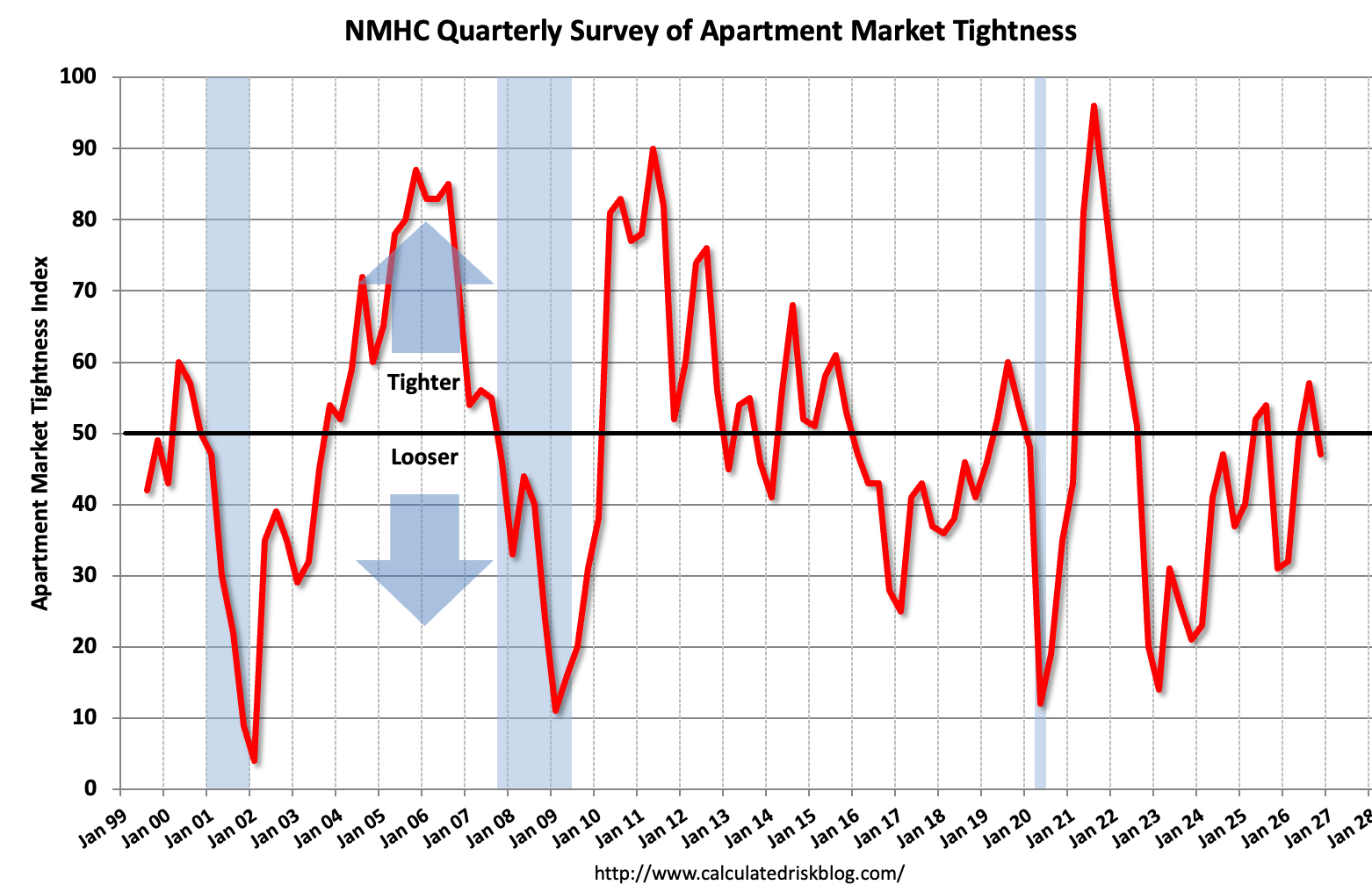
The quarterly index decreased to 47 in October from 57 in July. Any reading below 50 indicates looser conditions from the previous quarter.
This index has been an excellent leading indicator for rents and vacancy rates, and this suggests vacancy rates and asking rents are still under some pressure - although the monthly survey of rents suggests some Emerging Signs that Asking Rents are Near a Bottom.
This NMHC quarterly survey and the monthly Architectural Billings Index should be watched for any signs of a future pickup in multi-family starts. They both suggest some further weakness.